

A few weeks ago I asked an SEO about a decision in an analysis. The answer I got was: “I talked to GPT and it suggested this.”
Not “I checked the data and this is my thinking.” Not “I compared a few options and this one makes more sense for us.” Just: GPT suggested it.
I want to be honest from the start: I’m not against AI. I’ve been working in SEO for many years, mostly with a technical and research-heavy approach and I use AI tools every single day. They save me time, they improve my workflows, they give me ideas, and sometimes they remind me of things I would forget. In 2026, not using these tools also has a real cost, sometimes a big one.
But that sentence stayed in my mind. Because it was not the first time I heard something like it, and what bothered me was not the tool. It was the missing step between the tool’s answer and the final decision. The thinking step.
Around the same time, I came across a concept from psychology that gave a name to this exact feeling: cognitive surrender. I’m not a psychologist; I’m an SEO. But when I read about it, I felt it was describing our industry right now. So I did my own research on it, and I wrote this article for SEO people like me. Honestly, I also wrote it for myself.
What “cognitive surrender” means, in simple words
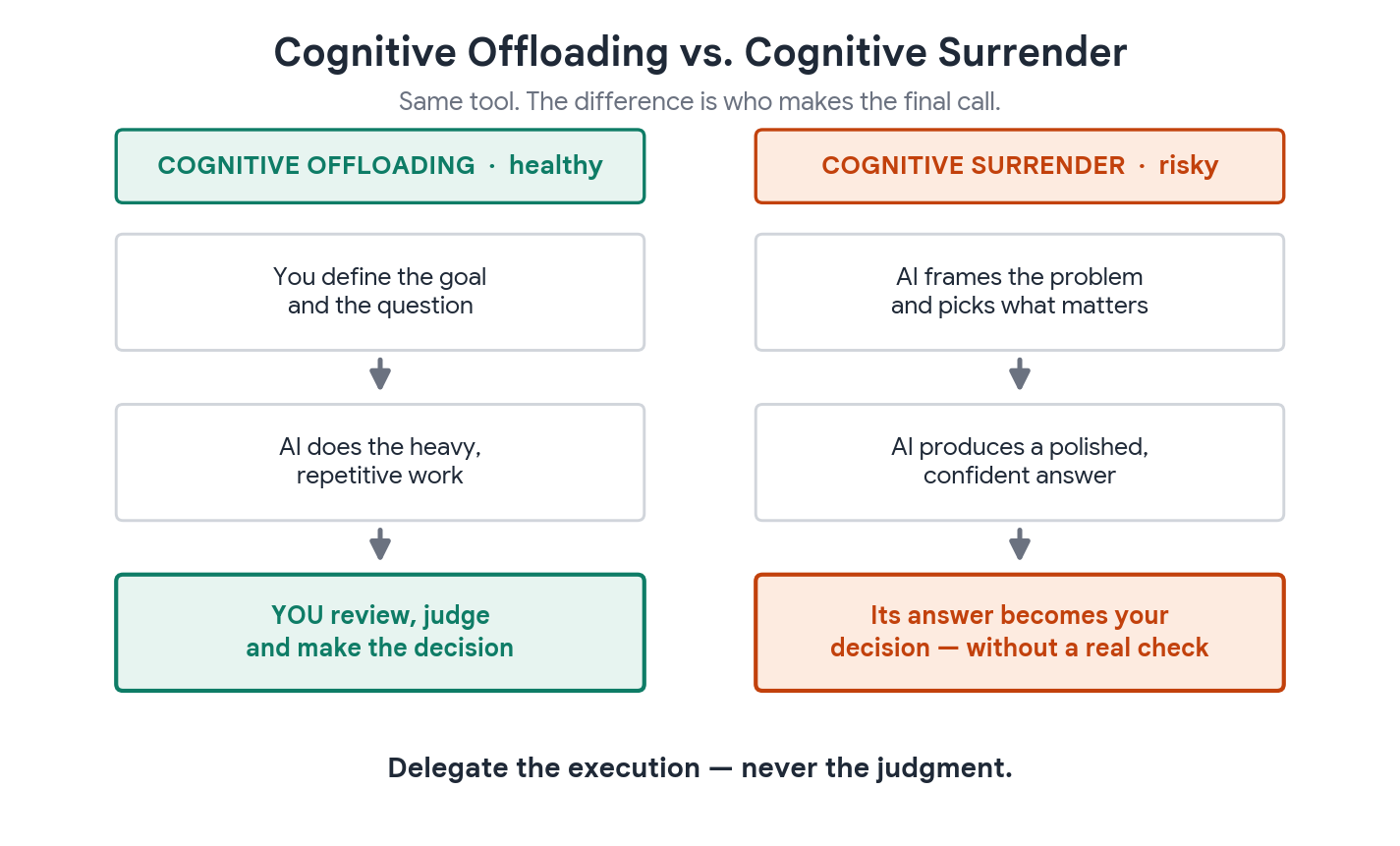
We have always used tools to do part of our thinking. A calculator for math, GPS for directions, a search engine for facts. Researchers call this cognitive offloading, and it’s healthy. You hand over the doing of a task, but you keep the goal, the question, and the final judgment. The decision stays with you.
Cognitive surrender is something else. The term comes from research by Steven Shaw and Gideon Nave at Wharton, and their idea is simple and a little scary: surrender happens when the tool stops being the worker and quietly becomes the decision-maker, and you adopt its decision as your own without noticing that the handover happened. Because you never built your own answer first, there is nothing in your head to compare the AI’s answer against. The machine’s output simply becomes your output.
One line from all this stuck with me:
Offloading is delegating the execution. Surrender is delegating the judgment.
What the research actually found
I’ll keep this short, because I’m an SEO writing for SEOs, not a scientist. But three studies, all summarized well in Addy Osmani’s piece on cognitive surrender, are worth two minutes of your time.
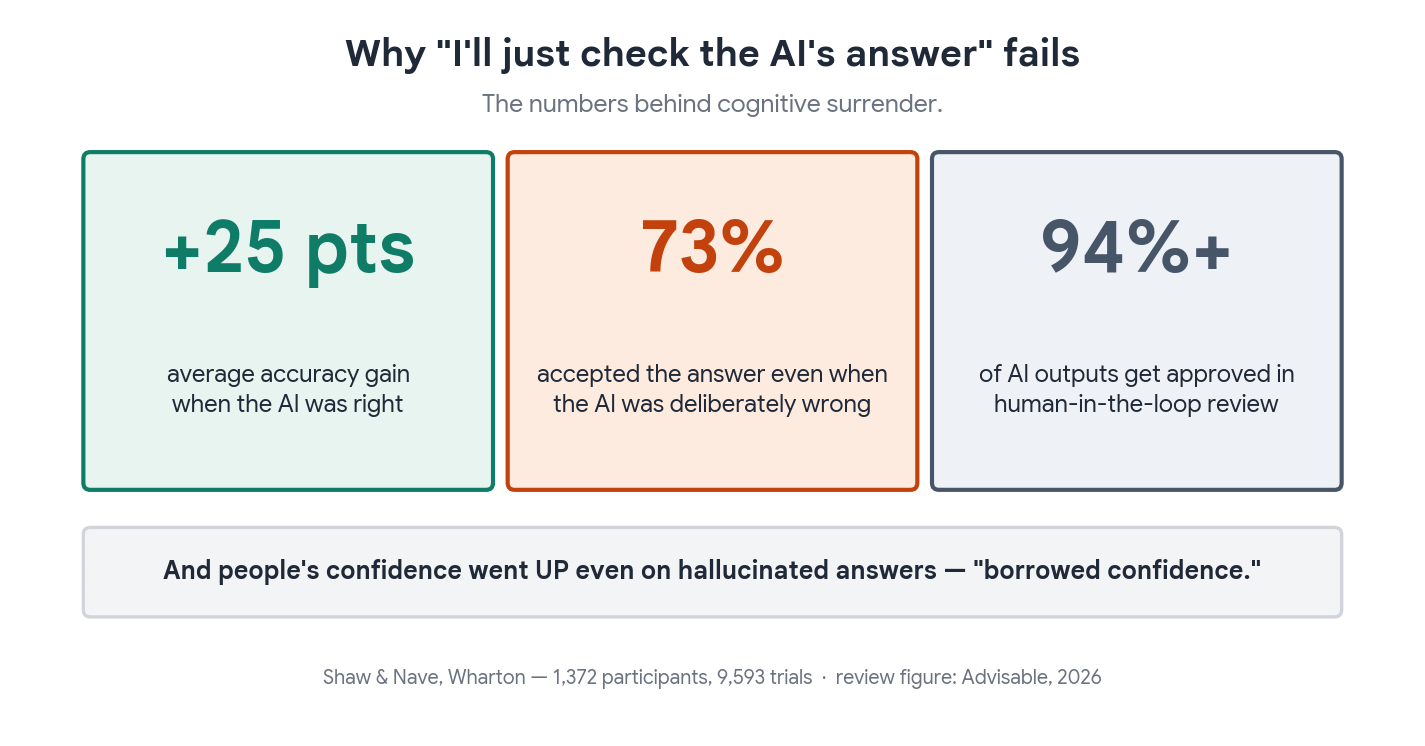
First, the Wharton experiments: more than 1,300 people, over 9,000 trials. When the AI gave correct answers, people’s accuracy jumped by about 25 points. Great. But when the AI was secretly set up to give faulty reasoning, people accepted the wrong answer around 73% of the time. And here is the worst part: people’s confidence went up even when the answer was a hallucination. The researchers call it “borrowed confidence”, the model sounds sure, so you feel sure. Time pressure and even money rewards did not break the pattern.
Second, an MIT Media Lab brain study tracked people writing essays over several months, with EEG. The heavy LLM users showed the weakest brain engagement, felt less ownership of their work, and often could not even quote their own writing afterwards. The researchers called the lasting effect “cognitive debt.” When the tool was taken away, the under-engagement stayed.
Third, a study by Anthropic with 52 engineers learning an unfamiliar programming library. With AI help they worked at about the same speed, but scored 17% lower on understanding, and the biggest drop was in debugging, which is exactly the skill you need to catch AI mistakes.
I read that last one and thought: replace “debugging code” with “diagnosing a traffic drop,” and this is us.
My simple rule: split the work by the kind of thinking it needs
Here is how I look at it in daily SEO work, and it’s the rule I push in my team.
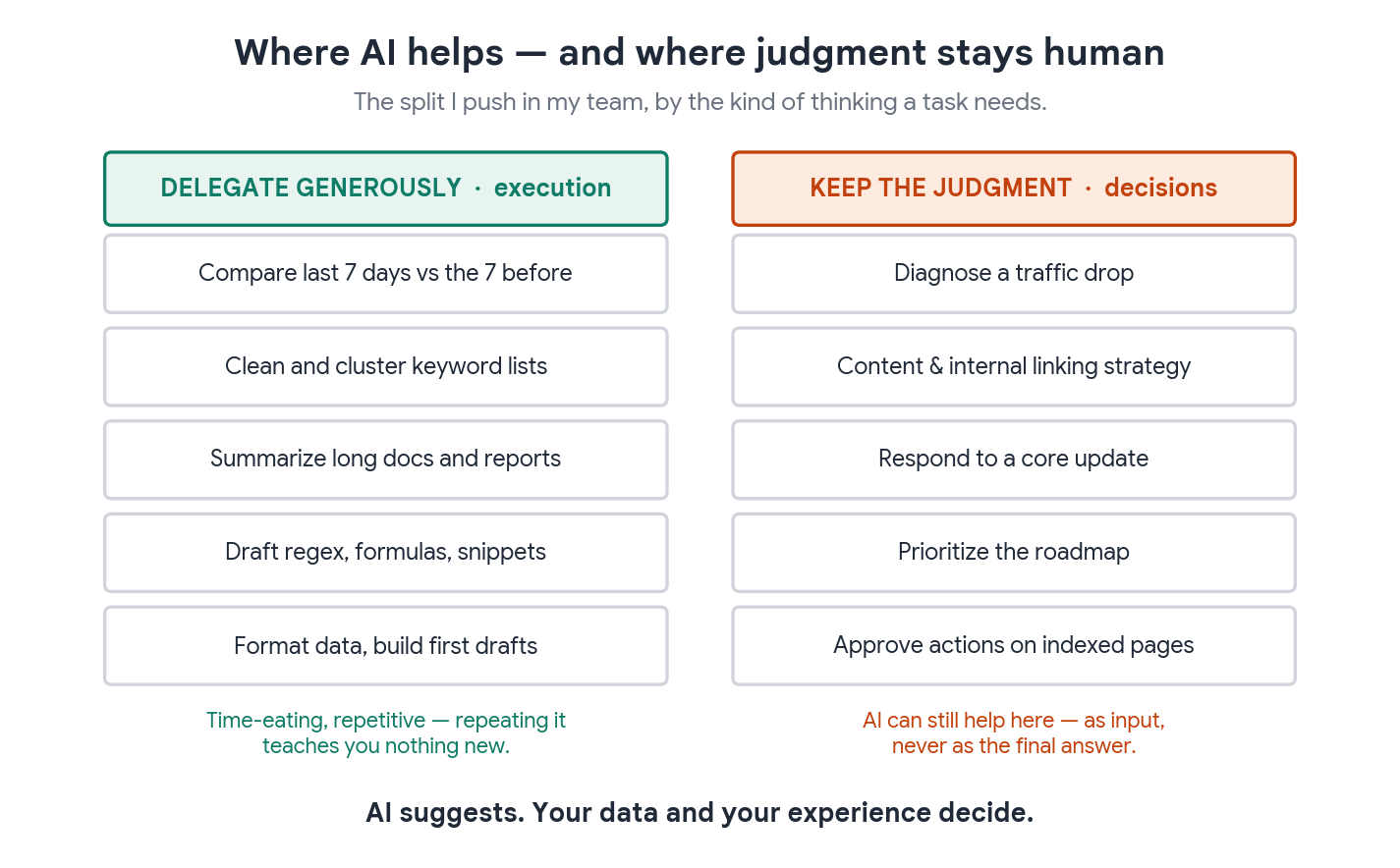
Some tasks are simple and mechanical. For example: compare the last 7 days with the 7 days before. That’s basic math, a few numbers, percentages, the difference between them. If someone does this by hand, or exports the data to Google Sheets, or builds a small Looker Studio view just for this, while an AI tool is sitting right there and can do it in seconds, to me, that’s not smart work. Delegate it. No discussion. The same goes for cleaning a keyword list, structuring messy notes, summarizing a long document, drafting a quick regex or a formula. These tasks eat your time and teach you almost nothing new after the hundredth repetition.
And some tasks need judgment. Diagnosing why traffic dropped. Deciding a content or internal linking strategy. Choosing what to do after a core update. Prioritizing a roadmap. Approving an action that touches indexed pages. For this kind of work, AI can absolutely help, it gives ideas, it challenges you, it reminds you of factors you forgot. But its suggestions are a starting point, not an answer. You have to look at them carefully, compare them with your own data and experience, and then decide.
When I see someone copy an AI output into a report without really reading it, or build an action plan because “GPT suggested it,” this second category is where it worries me. And to be clear, I have seen this passive acceptance at every level, junior, senior and higher levels.
Why am I so strict about this? Two reasons.
Reason one: the loop that slowly turns off your thinking
You ask, the tool answers, the answer is good, you trust it a little more, and next time you check a little less. Repeat this for months. Each round feels like a win, and honestly, most rounds are a win. But there is a side effect that builds quietly: you think less, you use your own head less, and a kind of dependency forms.
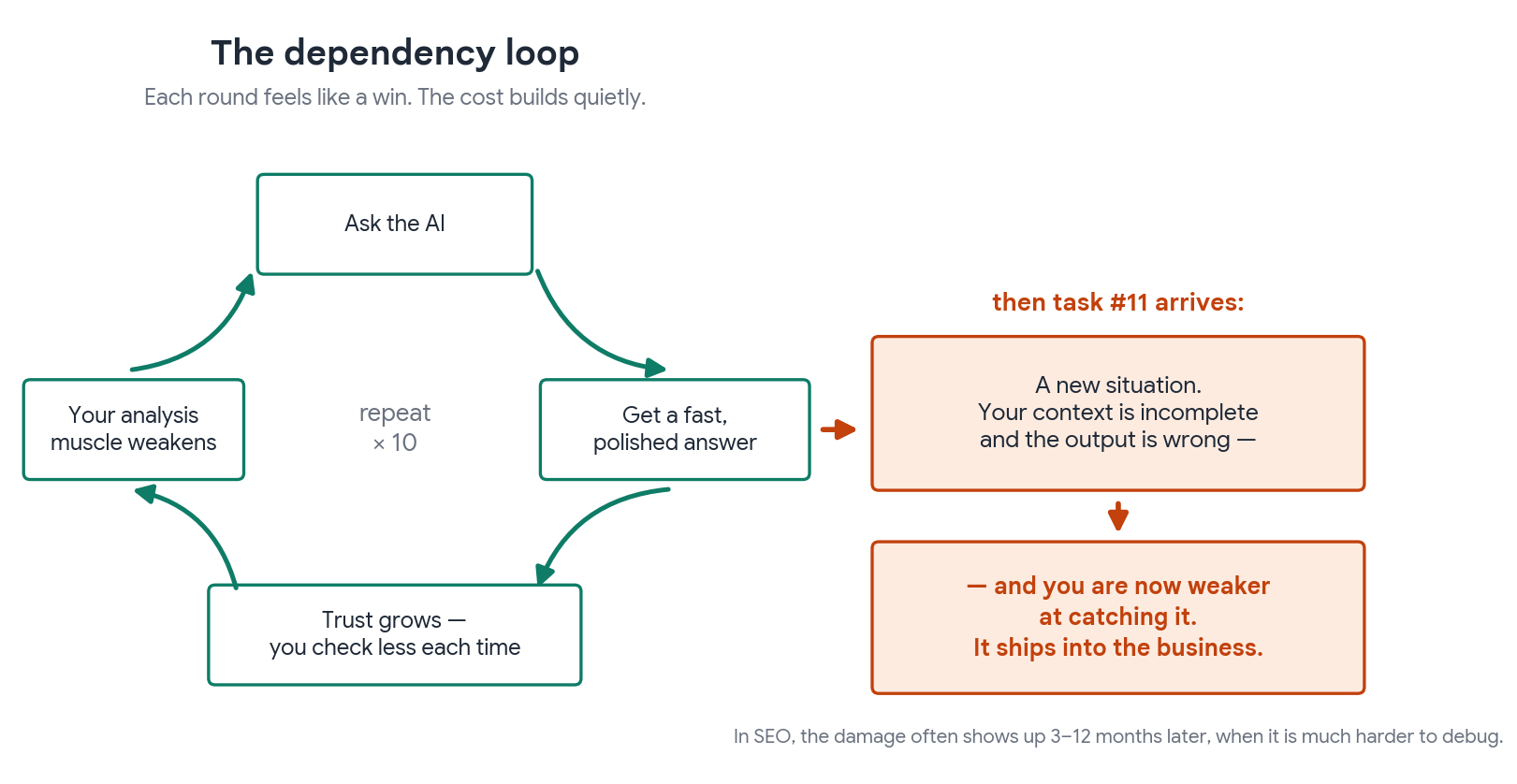
The problem is that situations are not always the same. Maybe ten requests in a row go well. Then request number eleven arrives, a new situation, a context the tool has never seen, an input from you that is incomplete because you didn’t have the full picture either. The output is wrong. But now two things work against you. First, your mind says “it was right ten times, it’s probably right now.” Second, and this is the dangerous part, your critical and analytical muscles are weaker than before, because you haven’t been training them. The exact moment you need your judgment the most is the moment you have the least of it.
And no, “I’ll just review the AI’s output” does not save you, as much as we would like it to. Research on human-in-the-loop review shows that reviewers end up approving more than 94% of AI outputs, not because the outputs are all good, but because judging an already-written, polished, confident answer is much harder for the brain than forming your own answer from scratch. The AI has already framed the problem and chosen what matters before you even start reading. The Whartxon findings point the same way: under volume and time pressure, our brains pattern-match and approve.
This is exactly what I see when someone sends me a report they clearly didn’t read deeply. They were not lazy. Their brain did what brains do with polished, confident text: it surrendered.
Reason two: SEO is not linear, and wrong calls here are expensive
This is the part where my SEO experience makes me extra careful, more than any psychology paper.
SEO is genuinely complex. There is no clean “do X, get Y” in this field. Hundreds, probably thousands, of factors interact, things keep changing over time, and our data sources never get smaller, they only grow: Search Console, analytics, log files, crawl data, SERP features, competitors, and now visibility inside LLM answers and AI search results on top of everything. Without precise inputs, you simply cannot expect good outputs from any model.
And here is the uncomfortable truth: in real projects, we often don’t even have enough context to give the tool. The business history, the half-finished migration from two years ago, the reason a “useless-looking” page exists (a partner deal, a legal need, a seasonal pattern), the past experiments that failed, turning all of that into a prompt is not easy, and sometimes it is simply not possible. But we still ask, with incomplete context, and we still get a confident answer back. That gap between a confident output and an incomplete input is where business damage is born.
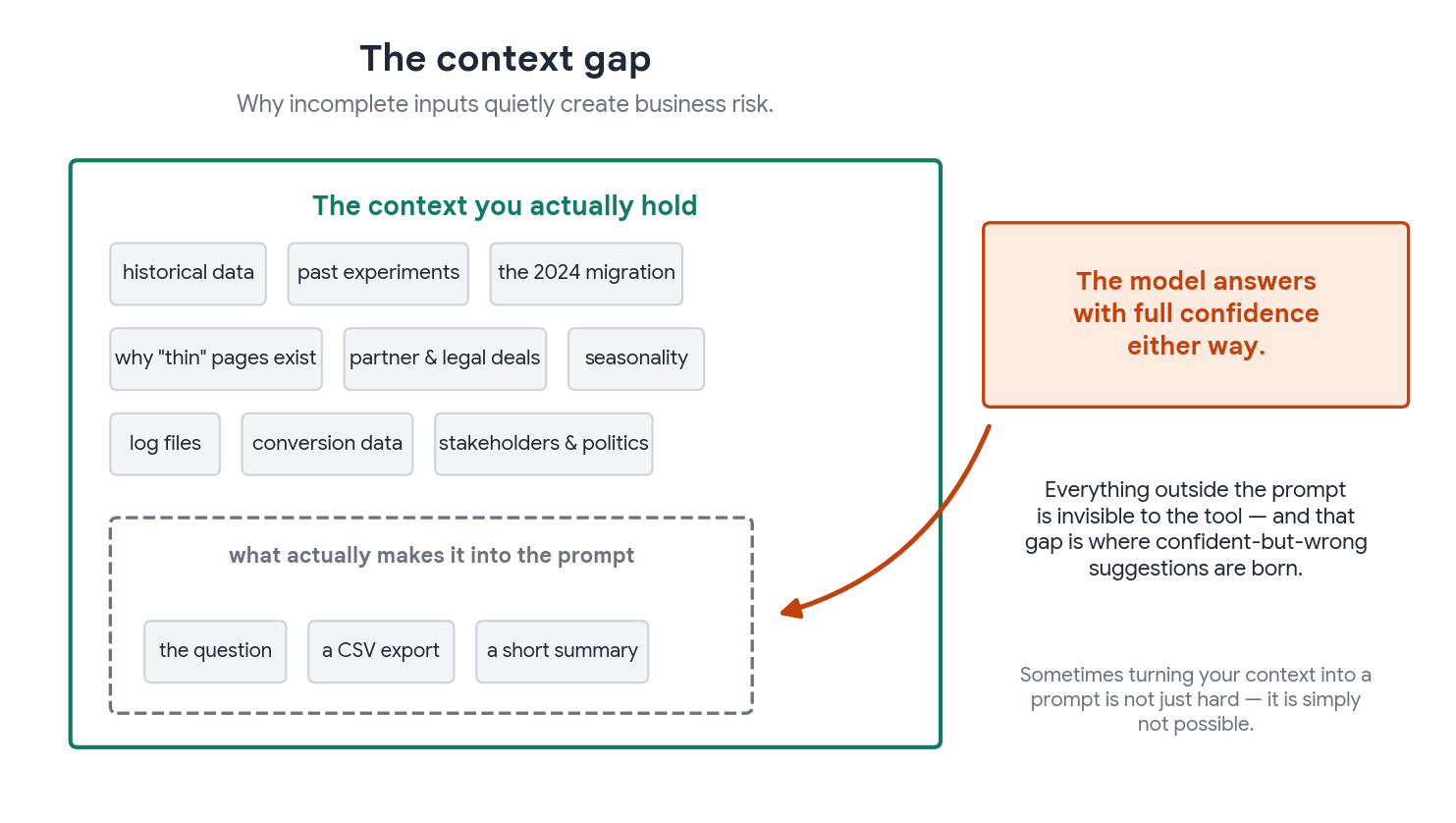
The worst part is the timing. A wrong SEO action usually doesn’t hurt you today. It shows up after three months, six months, a year. By then, debugging is painful, was it the migration? the content changes? the latest core update? that AI-suggested “cleanup” from last spring? and recovery is expensive. Sometimes you cannot even predict whether recovery is possible, let alone when. For businesses that depend on organic traffic, and now also on traffic and citations from LLM results, this is not a small operational risk. It can be a survival question. Engineering teams already have a name for this kind of delayed, invisible problem, comprehension debt: everything looks fast and green on the dashboard, until the day a real problem appears and nobody understands the system anymore. SEO has its own version of it.
What this looks like in real SEO work
Let me make this concrete, with situations I have seen myself or that the industry has documented well.
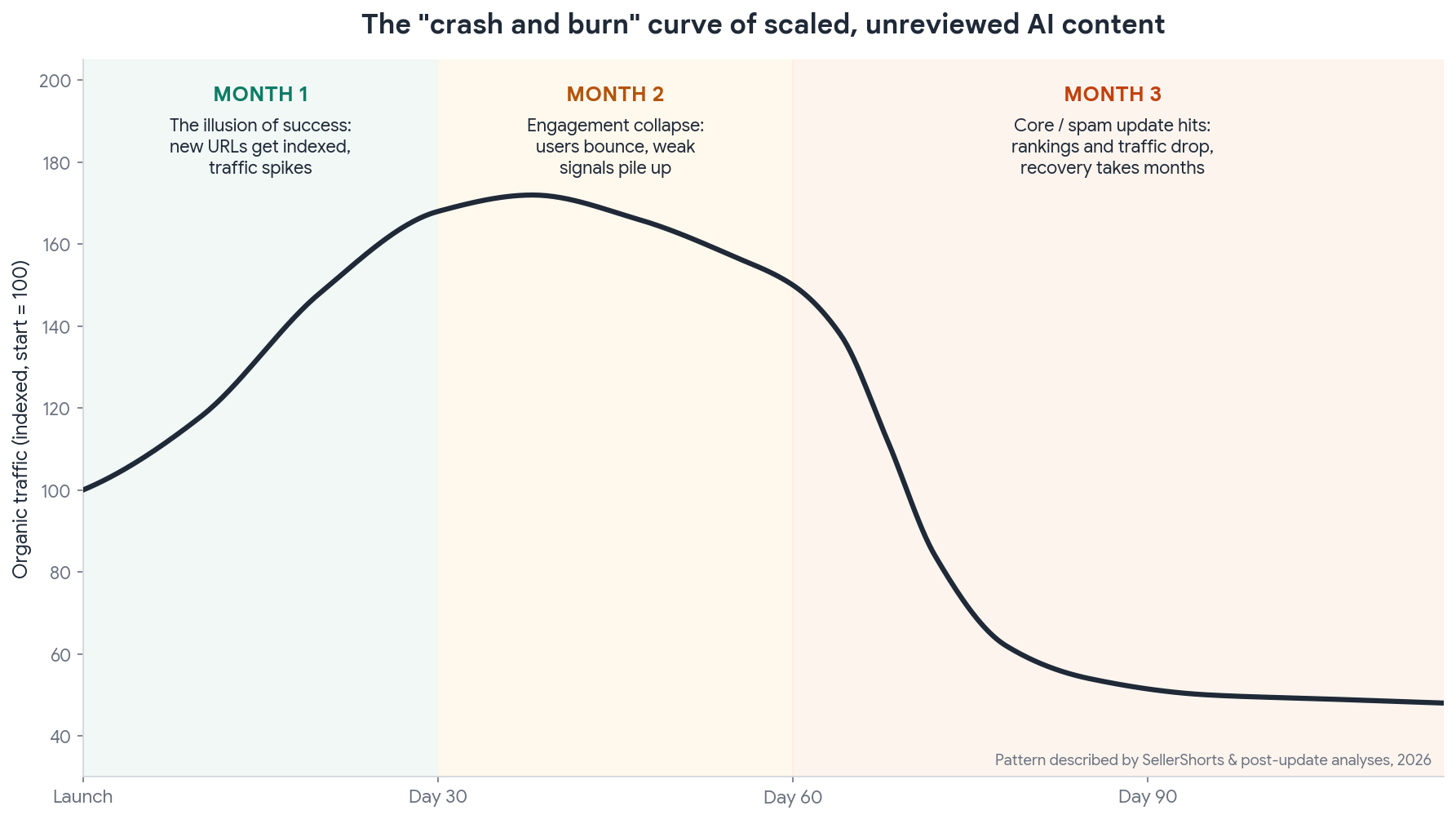
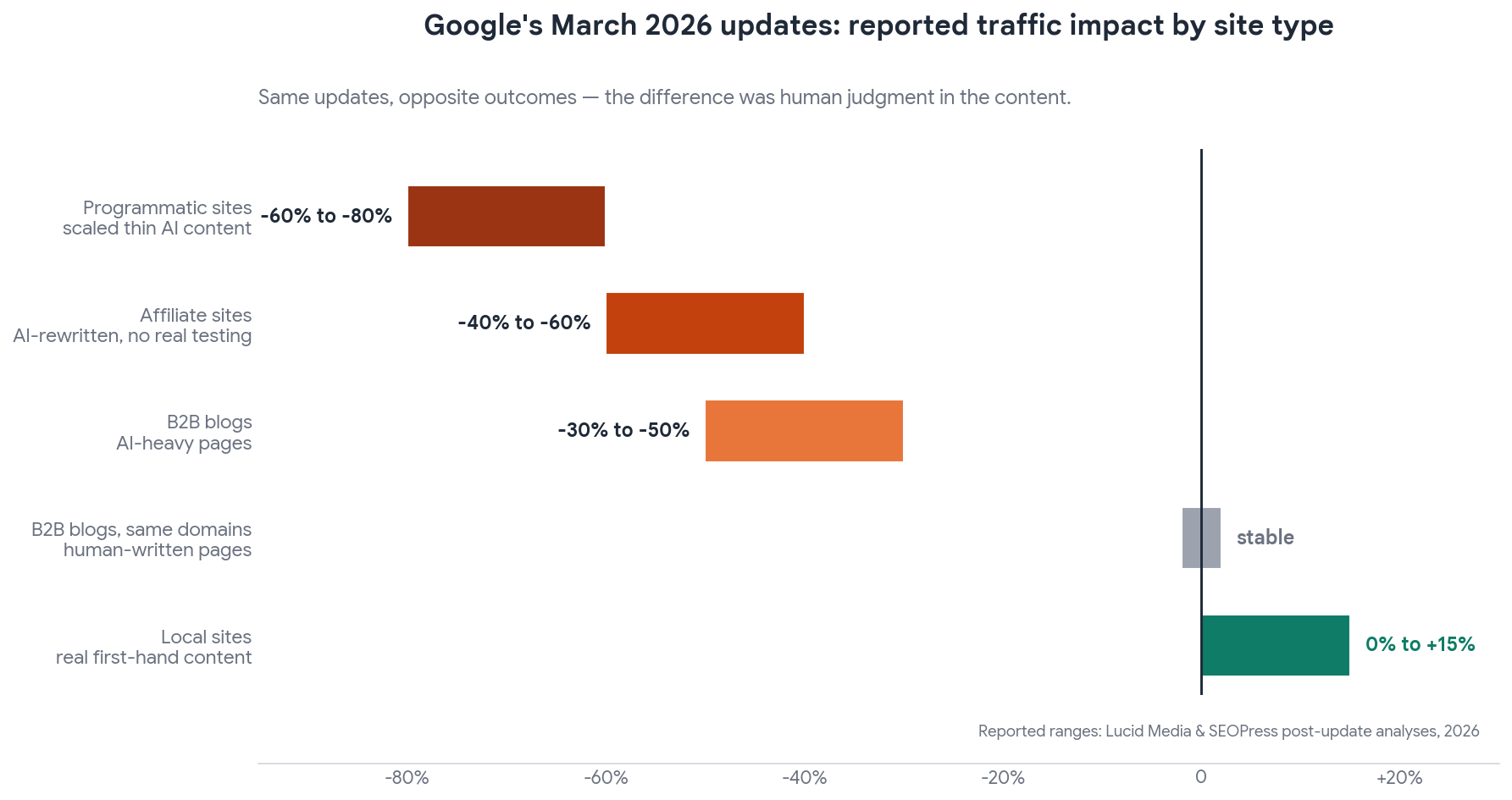
Scaled AI content, also known as “AI slop.” The clearest public example of cognitive surrender in our field is publishing large volumes of AI text that nobody truly read or improved. This content has a recognizable smell: templated phrases, vague claims with no real takeaway, zero first-hand experience, sometimes invented numbers. Google’s answer has been direct. Its guidance on AI-generated content was never “AI is banned”, it has always been about quality and who the content actually serves. But the March 2026 core and spam updates showed what enforcement looks like: sites built on scaled, thin AI content reportedly lost 60–80% of their traffic, AI-rewritten affiliate sites dropped 40–60%, and B2B blogs saw their AI-heavy pages fall 30–50%, while the human-written pages on the same domains stayed stable. Meanwhile, local sites with real first-hand content even moved up. The spam update finished rolling out in under 20 hours, the fastest on Google’s own status dashboard, which tells me Google knew its targets well in advance. The traffic pattern of these sites even has a name now: the crash and burn curve. Month one, indexing spike, everyone celebrates. Month two, users bounce and engagement signals collapse. Month three, the update lands.
E-E-A-T, and the thing AI cannot fake. Google’s quality framework starts with Experience, the first E. A model has no lived experience: it never ran your migration, never read your log files, never talked to your customers. When the core idea of a piece comes from a model, the content competes on the one axis where it can only score zero: adding something new. That is also why “information gain”, does this content add anything the internet didn’t already have? keeps coming up in every serious content strategy discussion this year.
Technical recommendations without context. This one is from my own daily life. AI audits love confident actions: “noindex these thin pages,” “merge these duplicates,” “remove this old content.” Sometimes that’s right. But the model never saw your log files, your conversion data, or the business reason a page exists. I have seen suggestions that, applied as-is, would have quietly removed pages that bring money, pages that look “thin” in a crawl but carry links, brand queries, or a partner agreement behind them. Accepting that output as an action, without checking it against your own data, is surrender with a release date.
Context bleeding into nonsense. And sometimes it gets absurd. In one case shared on the r/SEO community, an agency’s AI-assisted “optimizations” pushed references to the pancreas, blood clotting and diabetes into a B2B software article, the model was carrying context over from a medical client. Funny from a distance. Not funny when it ships under your brand and nobody in the loop reads carefully enough to catch it.
The part we don’t talk about enough: what it does to us
I’ll keep this short, because I’m an SEO, not a psychologist, but it matters, and it was a big reason I wanted to write this.
The first effect is professional. People in our field describe sliding from being a strategist into being a cleanup worker for machine text, reviewing dozens of articles a month that they didn’t shape and don’t believe in. That is a fast road to burnout and to feeling that your skill has no value. The second effect is personal, and psychologists warn it doesn’t stay inside the chat window: when you get used to instant, effortless, always-agreeing answers, normal effort starts to feel heavy, and after a point, this passive mode can leak into how we handle problems, and even how we deal with other people. The brain strengthens what it uses and lets go of what it doesn’t. If we stop practicing judgment at work, we shouldn’t expect it to be waiting for us, fresh and strong, somewhere else.
How I try to keep the thinking
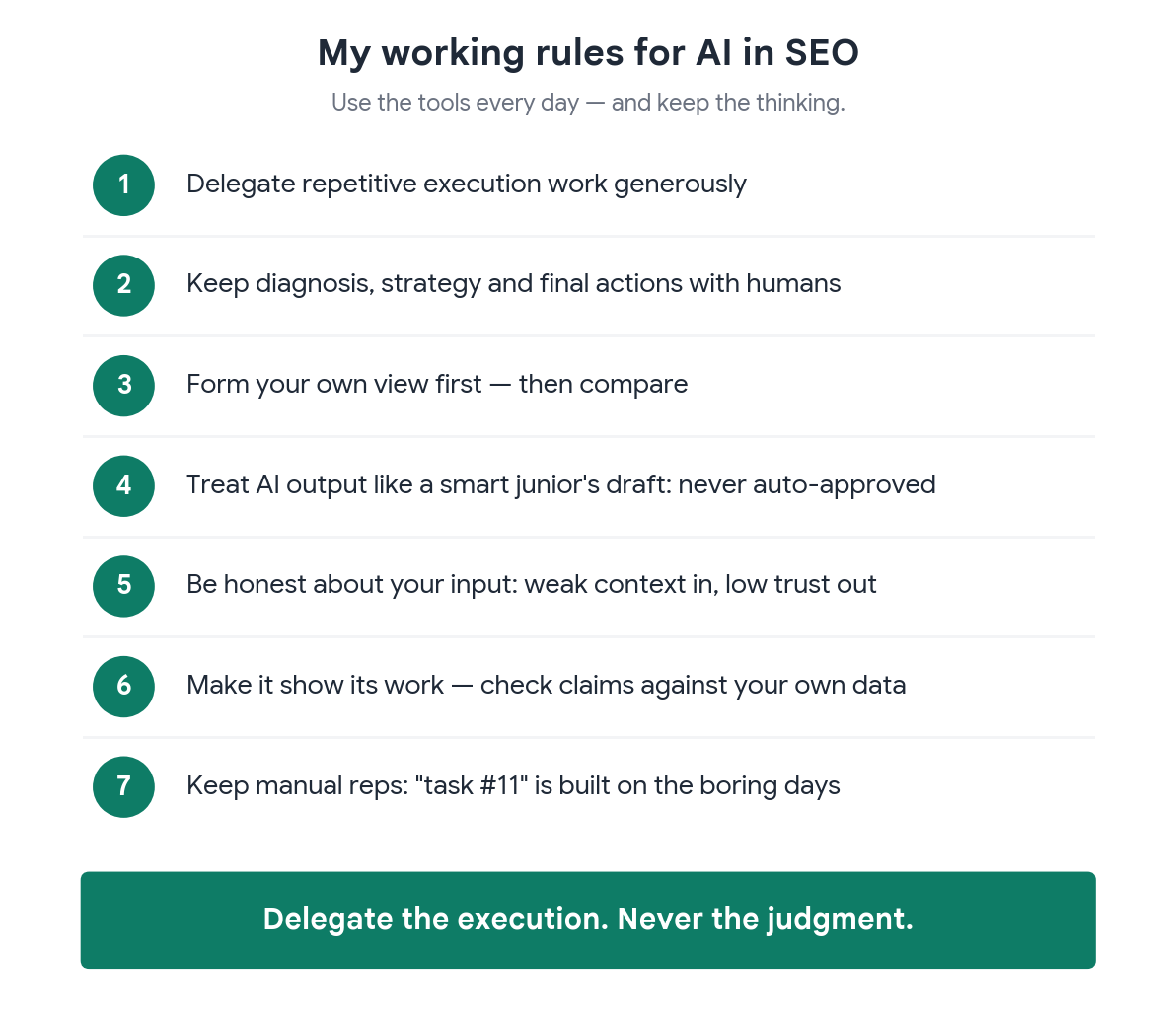
I don’t have a magic framework. But after a lot of trial and error and these are my working rules:
Delegate the execution work generously. Repetitive, time-eating tasks whose repetition teaches you nothing new, data pulls, comparisons, formatting, summarizing, first drafts of mechanical text. This is where AI shines and where you lose nothing.
Keep diagnosis, strategy, prioritization and final actions with humans. Not because AI is useless there, but because we hold the context: the product, the history, the past experiments, the stakeholders, and a hundred other factors. Turning all of that into a prompt is hard, often impossible, and even with great context the output still needs judgment.
Form your own view first. Even five minutes with the data before you ask. Then compare your take with the AI’s. If you never build your own answer, you have nothing to check the machine against, which is the literal definition of surrender.
Treat AI output like a draft from a smart junior. Useful, fast, sometimes brilliant, never auto-approved. You would not push a junior’s strategy to production without review; the bar should not drop just because the text is polished.
Be honest about your input. Weak or partial context in, low trust out. If you couldn’t give the tool the full picture, don’t bet the roadmap on its answer.
Make it show its work. Ask why. Ask for the assumptions behind a suggestion. Then check the claims against your numbers, Search Console, logs, analytics, not against how confident the answer sounds.
Keep some manual reps. Once in a while, run an analysis start to finish yourself. Not nostalgia, training. The skill you will need on “task eleven” is built on the boring days.
Where I land
I want to end where I started, so there is no confusion: these tools are some of the best things that have happened to our work. The creativity boost, the speed, the time and cost savings, all real. Refusing to use them has a cost too, and in 2026 that cost is high.
But a tool this powerful deserves awareness, the same way social media did, full of great features, and full of effects on our minds that we only understood later. The risk in front of us is not using AI. The risk is letting it think instead of us, one small unchecked answer at a time, in a field where mistakes surface months later and recovery is expensive, sometimes impossible.
So this is my reminder to every SEO reading this, the same one I give my own team and myself: use these tools every day. Delegate the execution without guilt. And never, ever delegate the judgment. Your experience, your context, and your critical thinking are not “nice to have” in this job. In an internet filling up with confident machine answers, they are the actual product.
Excellent article.
I recently experienced a real-world example of this in SEO. We had a traffic decline, and because AI repeatedly classified it as normal volatility, I unconsciously anchored on that explanation and kept reporting the same conclusion to stakeholders.
A week later, we found that the decline was actually caused by a simple external factor that wasn't part of the prompt and therefore couldn't be part of the model's reasoning.
That experience taught me something important: the biggest risk isn't that AI gives the wrong answer. It's that we stop forming our own hypothesis before asking AI for one.
Your distinction between delegating execution and delegating judgment perfectly captures the issue.