

A six-month follow-up to “I Analyzed 6,000+ SEO Job Postings. Here’s What AI Actually Changed.”
Six months ago I pulled 6,400 SEO job descriptions from LinkedIn and asked a simple question: was anything actually changing because of AI, or was it all conference-stage theatre?
The answer back in December 2025 was yes, but quietly. About one in six postings mentioned AI search or LLM-related terms. The US was running ahead of the rest of the world. Leadership roles were absorbing the new vocabulary first.
I just ran the same analysis again with a fresh pull — 5,931 postings across the same six countries (plus Japan this time).
The very short version: every signal that was emerging in December is now mainstream, and the part of the workforce that wasn’t asked for AI fluency six months ago, junior hires, is the segment that changed the most.
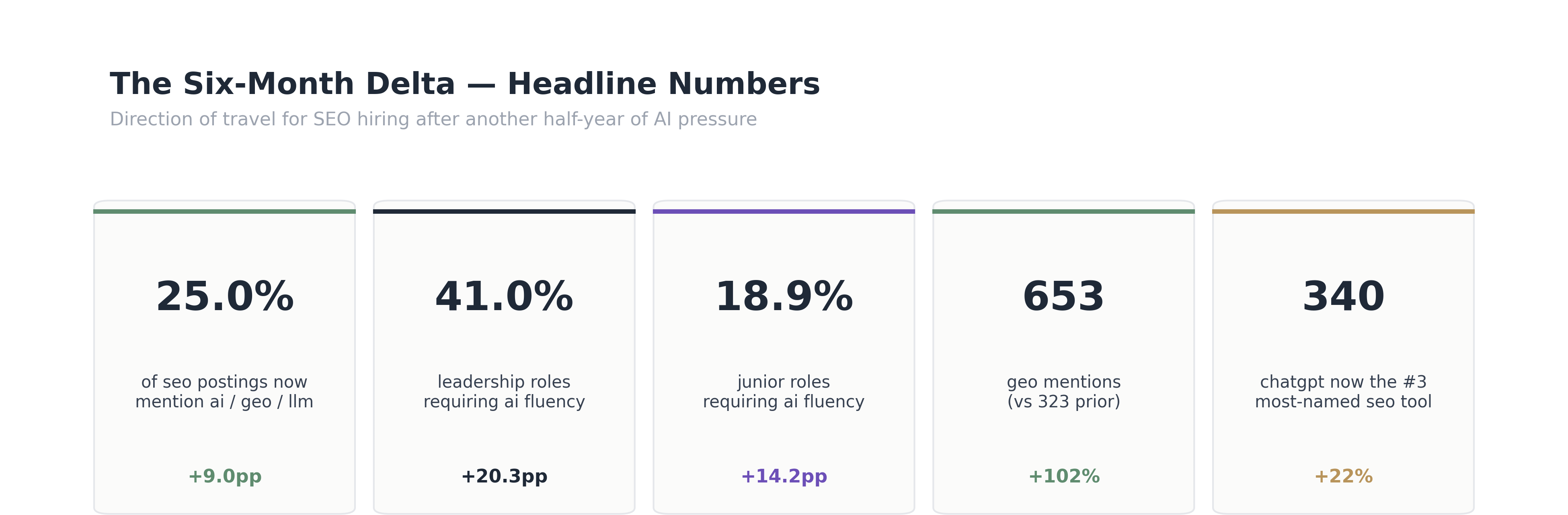
The six-month delta in one screen
1. The vocabulary moved from emerging to default
In December, GEO was the term that was clearly winning the naming war, 323 mentions versus 128 for AEO. Both terms have now roughly doubled, and so has LLM (210 → 539). ChatGPT, which was already the loudest specific tool, grew more modestly to 340.
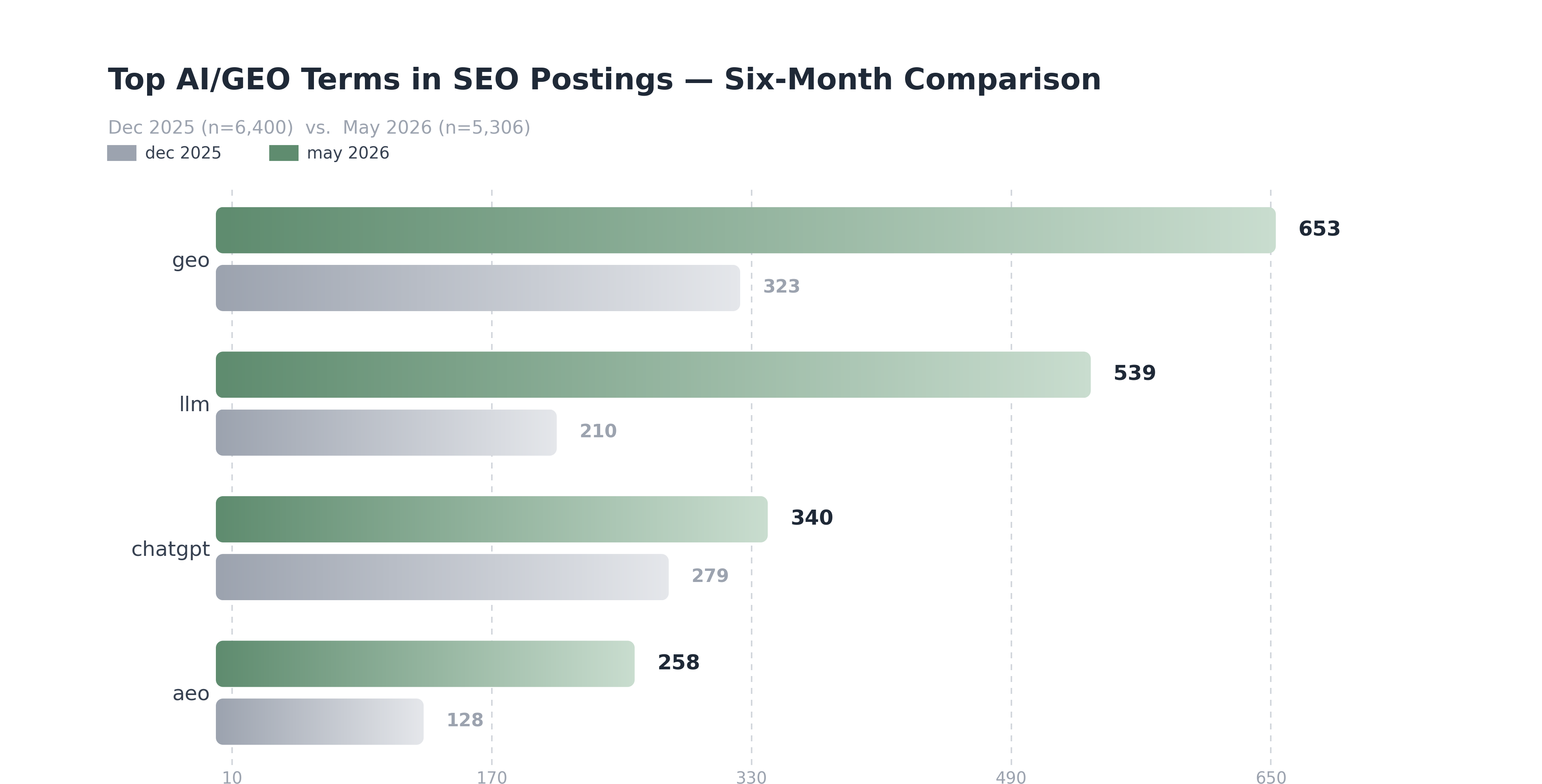
Chart 1 — Every AI-search term in SEO postings roughly doubled in six months
Stack those together with Claude, Perplexity, Gemini, generative AI and the rest, and 25% of all SEO/marketing job postings now mention AI search or LLM-related terms in the six-country comparable sample. That’s up from ~16% in December.
One in four. That’s the line we crossed.
This is no longer a leading indicator. It’s a hiring norm.
2. The US still leads, but the rest of the world is catching up fast
The most striking pattern in December was how lopsided AI/GEO adoption was: 23.3% in the US, single digits everywhere else outside Germany. That gap has narrowed, not because the US slowed down, but because every other market roughly doubled.
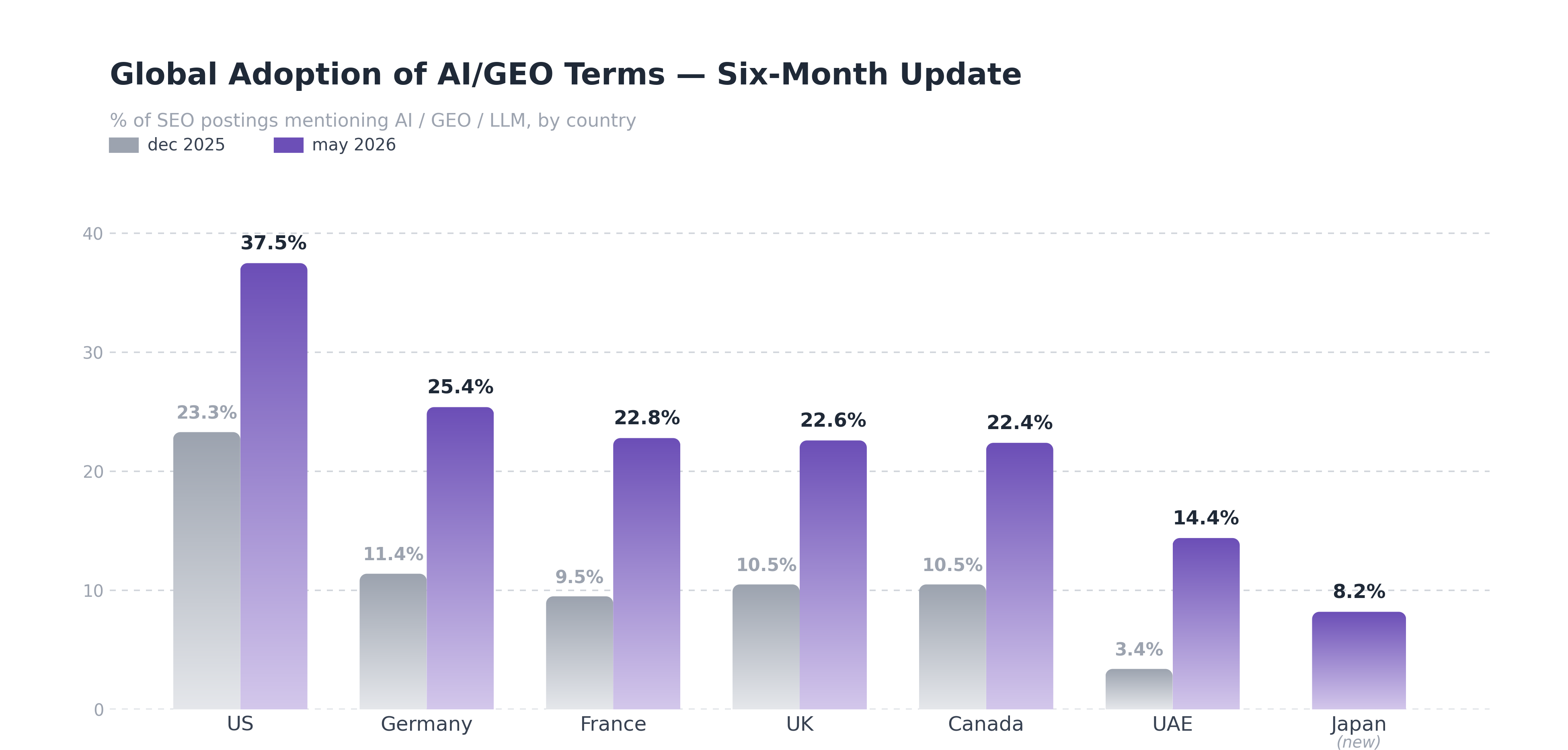
Chart 2 — The US still leads, but every market doubled
• United States: 23.3% → 37.5% (+14.2pp)
• Germany: 11.4% → 25.4% (+14.0pp)
• United Kingdom: 10.5% → 22.6% (+12.1pp)
• Canada: 10.5% → 22.4% (+11.9pp)
• France: 9.5% → 22.8% (+13.3pp)
• UAE: 3.4% → 14.4% (+11.0pp)
And the new addition, Japan, comes in at 8.2%, roughly where the Western European markets were six months ago.
The US is still where the AI-SEO conversation is hottest, and where you’ll see the most aggressive job descriptions.
3. Junior roles are where the biggest shift happened
This was the most surprising finding when I re-ran the seniority cut.
In December, AI/GEO adoption was concentrated at the top: Leadership (20.7%), Manager (20.1%), Junior (4.7%). That looked like classic strategy-rolls-down behaviour: experienced people figure out the new thing, then it works its way into entry roles.
What actually happened is that every tier moved up sharply, but junior roles moved fastest in relative terms.
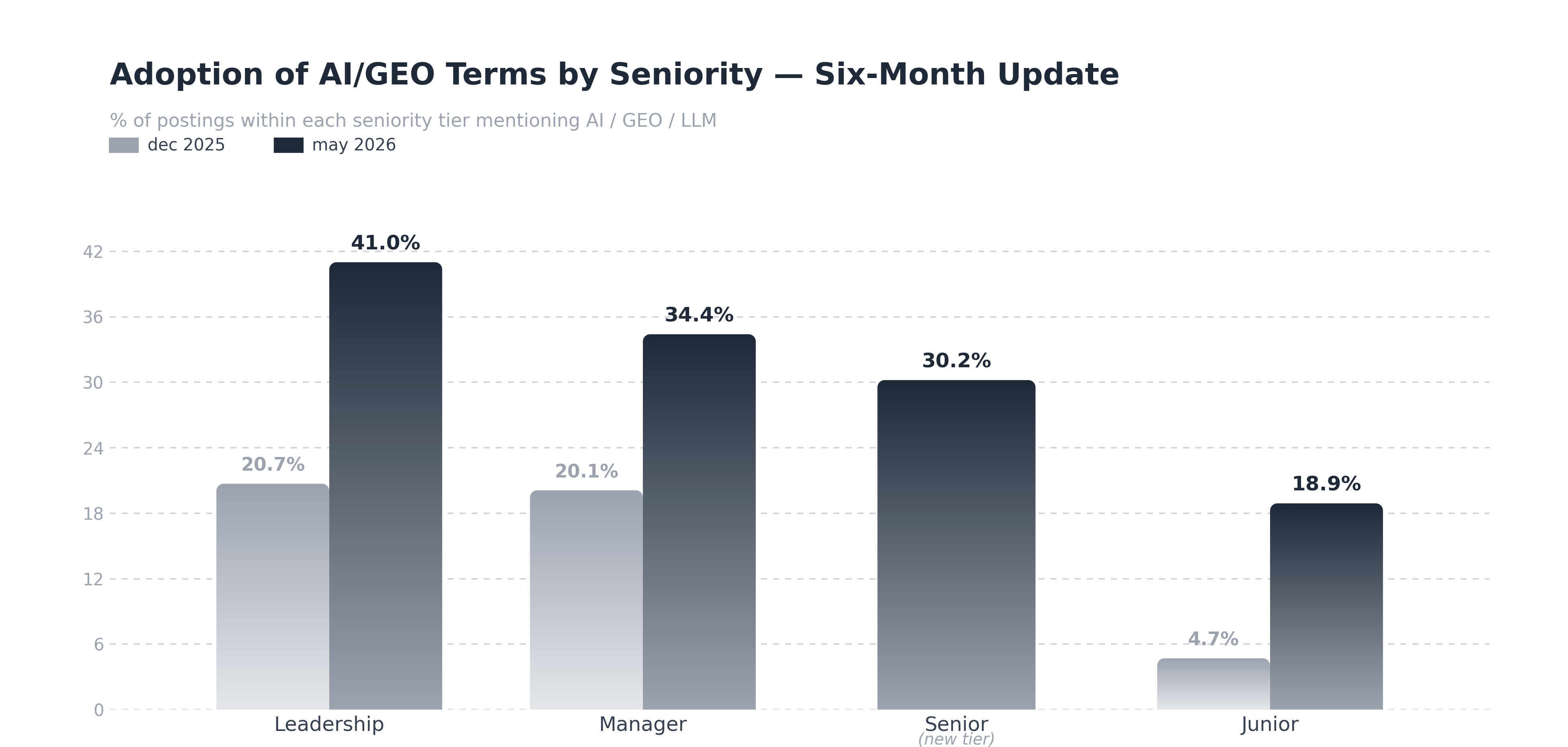
Chart 3 — AI requirements are no longer just a leadership thing
• Leadership: 20.7% → 41.0% — roughly double. Senior people are now expected to be conversant in AI search at almost half of openings.
• Manager: 20.1% → 34.4%.
• Senior / Lead (new cut this round): 30.2%.
• Junior / Entry-level: 4.7% → 18.9% — four-fold increase.
I read this two ways. The optimistic read: employers have decided AI tooling is a baseline competency, and they want it in the door from day one. The cynical read: with so few entry-level SEO openings being posted in absolute terms, employers are using AI/GEO requirements as a filter to thin the applicant pile.
Both are probably partially true. Either way, “junior” no longer means “tool-free.”
4. The tool stack: ChatGPT is now top-3, and Claude is the dark horse
The classic toolkit hasn’t gone anywhere. Google Analytics is still mentioned in 1,116 postings (essentially unchanged from December’s ~1,100). Search Console, Ahrefs, Screaming Frog and Semrush are all firmly entrenched.
But two interesting things happened:
1. Semrush slipped — 697 → 589 mentions. Still huge, but the only classic tool to lose ground in absolute mentions.
2. ChatGPT is now the #3 most-named tool at 340 mentions, ahead of Ahrefs and within striking distance of Semrush.
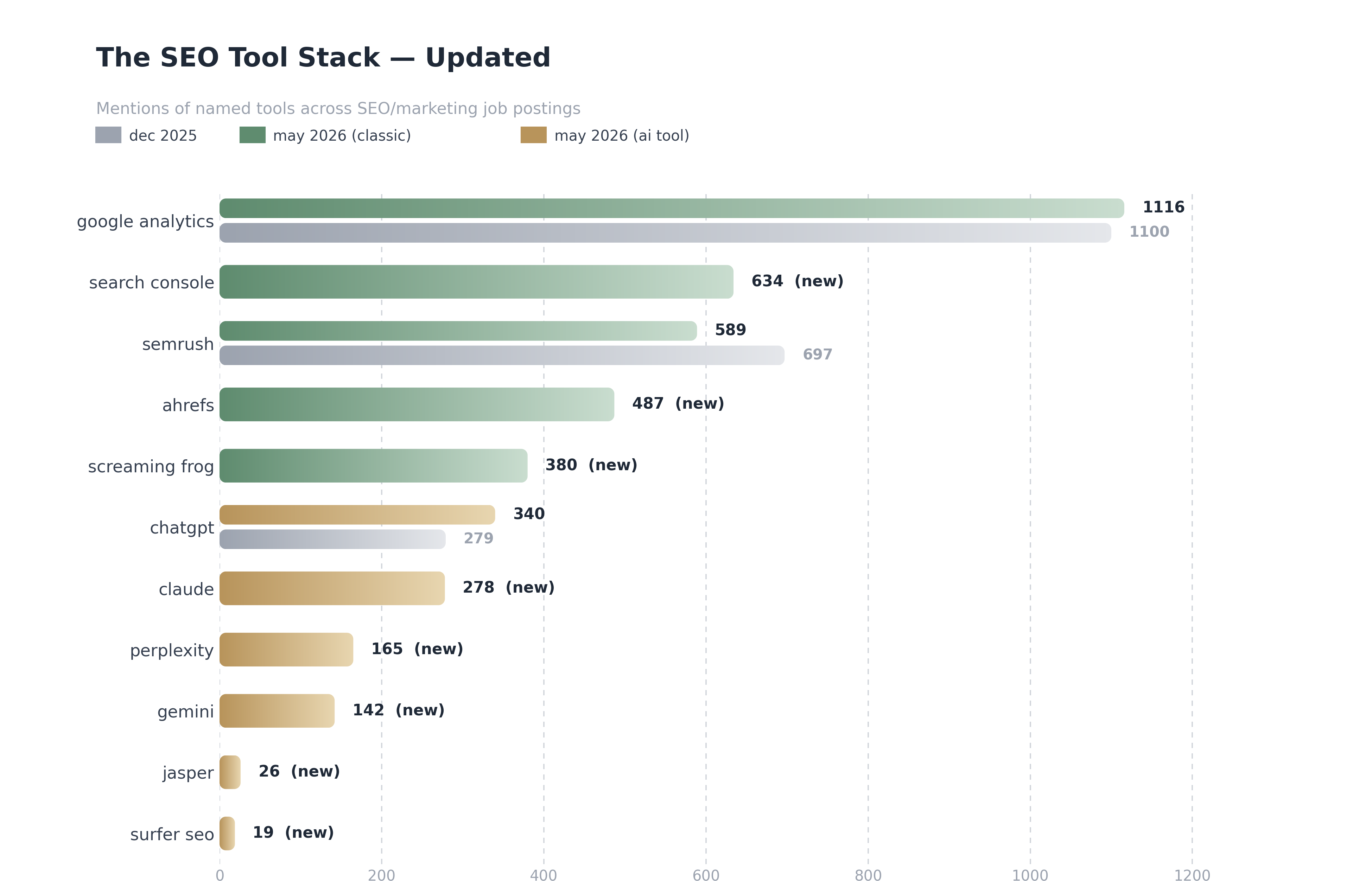
Chart 4 — ChatGPT is closing the gap with the classic SEO toolkit
The bigger story underneath the ChatGPT line: Claude has appeared from nowhere with 278 mentions, Perplexity is at 165, Gemini at 142. None of those were named tools in the December analysis in any meaningful volume.
That shift matters because it kills the narrative that “ChatGPT is shorthand for AI.” Recruiters are increasingly naming specific models, which means they’re starting to have an opinion about which AI tools matter for the role. Claude in particular shows up most often in technical and analytical postings; Perplexity in research-oriented ones.
Specialized AI writing tools (Jasper, Surfer SEO) are still niche, 26 and 19 mentions respectively. The market hasn’t fragmented at the writing layer. It has fragmented at the model layer.
5. The “AI jobs need coders” finding still holds, but at a lower altitude
In December I reported that 29.7% of AI-focused SEO jobs required Python/SQL/similar, vs. 14.2% for traditional SEO jobs, a roughly 2.1× gap.
That gap is still there. But both numbers came down.
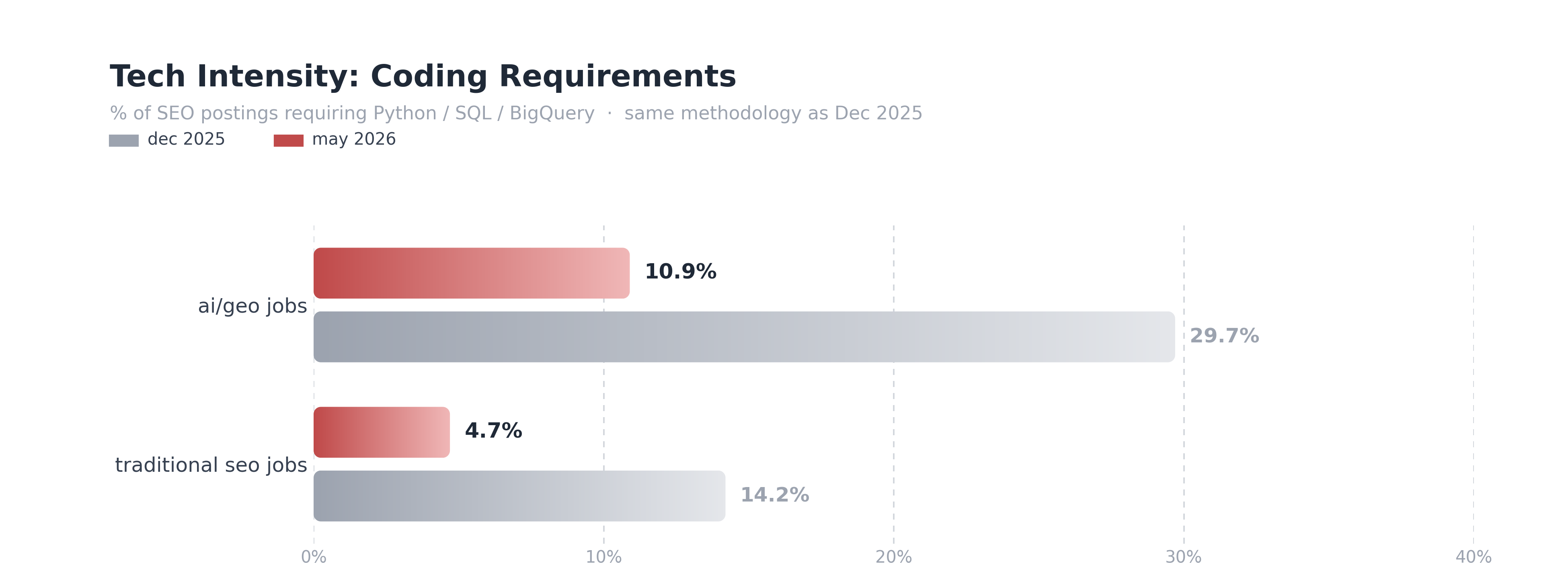
Chart 5 — AI-focused SEO jobs still demand code roughly 2.3× more often
• AI-focused SEO jobs requiring Python/SQL: 29.7% → 10.9%
• Traditional SEO jobs requiring Python/SQL: 14.2% → 4.7%
• Relative gap: 2.3× (essentially unchanged)
What’s going on? My best read: when AI search optimization was new, employers wanted humans who could build the analysis pipelines themselves. Six months on, a lot of that has been packaged into off-the-shelf products and AI agents. You no longer need to write the Python to talk to an LLM about your sitemap, there are five startups that will do it.
The AI tools, in other words, are doing the coding. The job description is downgrading accordingly.
That doesn’t make technical fluency obsolete. 52% of AI-focused SEO postings still ask for Technical SEO skills vs. 36% of traditional postings, a +16pp gap that’s almost identical to the +19pp I measured in December. Schema, crawl architecture, and site speed have not gotten any less important. They’ve gotten more important relative to traditional SEO. They just don’t always come with a “must write Python” clause anymore.
6. What didn’t change
Worth flagging the steady state, because it’s easy to overstate the AI story:
• Google Analytics is still the most-mentioned tool, by a wide margin.
• Keyword research still appears more often than GEO.
• Content / editorial skills remain the second-most-mentioned cluster after analytics.
• Full-time is still 89% of SEO postings; freelance/contract didn’t surge the way some predicted.
• The fundamentals haven’t been replaced. They’ve just acquired a new layer on top.
If anyone tells you to forget Search Console and learn prompt engineering, they’re selling a course.
What this means for your career (updated)
In December I said: if you’re an SEO professional planning to keep doing exactly what you’ve been doing, you’ll probably be fine for now.
I’d revise that downwards. The window is closing. The “for now” was the operative phrase, and six months later “now” looks shorter than I assumed.
Three things I’d do this quarter if I were job-hunting:
3. Pick one AI tool and go deep. Not “I’ve tried ChatGPT” deep, “I’ve shipped three workflows with it” deep. Claude or ChatGPT is fine. Recruiters are starting to name specific models; specificity now beats breadth.
4. Learn to talk about GEO and AEO without sounding like a LinkedIn post. What changes about your sitemap when an LLM is the visitor? What does internal linking do for citation rates? If you can answer those questions concretely, you are now in the top 25% of applicants.
5. If you’re entry-level, treat AI fluency as table stakes, not a differentiator. Six months ago AI on your CV got you noticed. Now its absence gets you skipped.
For employers: the data says you should stop hiring “an SEO” and start hiring for a hybrid you may have to define yourself. There is no clean job spec that does both AI search optimization and traditional SEO well, because the field is still inventing one. The companies that win are the ones that figure it out before the spec stabilises and salaries reset.
What I’d watch in the next six months
A few things I’ll be tracking when I run this analysis again at the end of 2026:
• Does junior AI-fluency hit 30%? If the slope holds, yes.
• Does Semrush keep losing share, or does it ship the AI feature that wins it back?
• Does any single AI tool consolidate to >50% of the AI-tool mentions, or does it stay fragmented?
• Does Japan’s adoption curve look more like the US or more like France? That tells us whether AI search adoption is a language-model-coverage story or a market-maturity story.
If any of you have a hypothesis on those, I’d love to hear it in the comments.
Methodology
• Source: LinkedIn job postings collected, 7 countries, United States, United Kingdom, Canada, Germany, France, UAE, and (new this round) Japan.
• Sample size: 5,931 total postings; 5,306 in the 6-country sample comparable to the December 2025 analysis.
• Term matching: Same regex-based pattern matching as the December article, exact word boundaries on “GEO”, “AEO”, “LLM”, “ChatGPT”, etc. applied to the full description text.
• “AI-focused” definition: A posting that explicitly names GEO, AEO, LLM, or ChatGPT in its description. The broader “any AI mention” category (used for the 25% headline) also includes Claude, Perplexity, Gemini, generative AI, and AI Overview references.
• Seniority: Inferred from job title using the same rules as the original article (Head/Director/VP = Leadership; Manager; Senior/Lead; Junior/Entry).
• Caveats: LinkedIn job descriptions are noisy. Some mentions are recruiter buzzword padding rather than real requirements. The directional signal is reliable; treat any single percentage with appropriate skepticism.
🔹Since the topic of artificial intelligence emerged and people started using it more or less, we’ve seen many experts oppose the tool and create countless stories around it, while others saw it as an incredible opportunity.
🔹Now, AI has become an inseparable part of both our work and daily life.
In fact, I believe that mastering AI should take priority over SEO expertise—like how you need to be familiar with using a computer before you can work in SEO.
🔹Thanks for the article, Sajjad Ghabel